
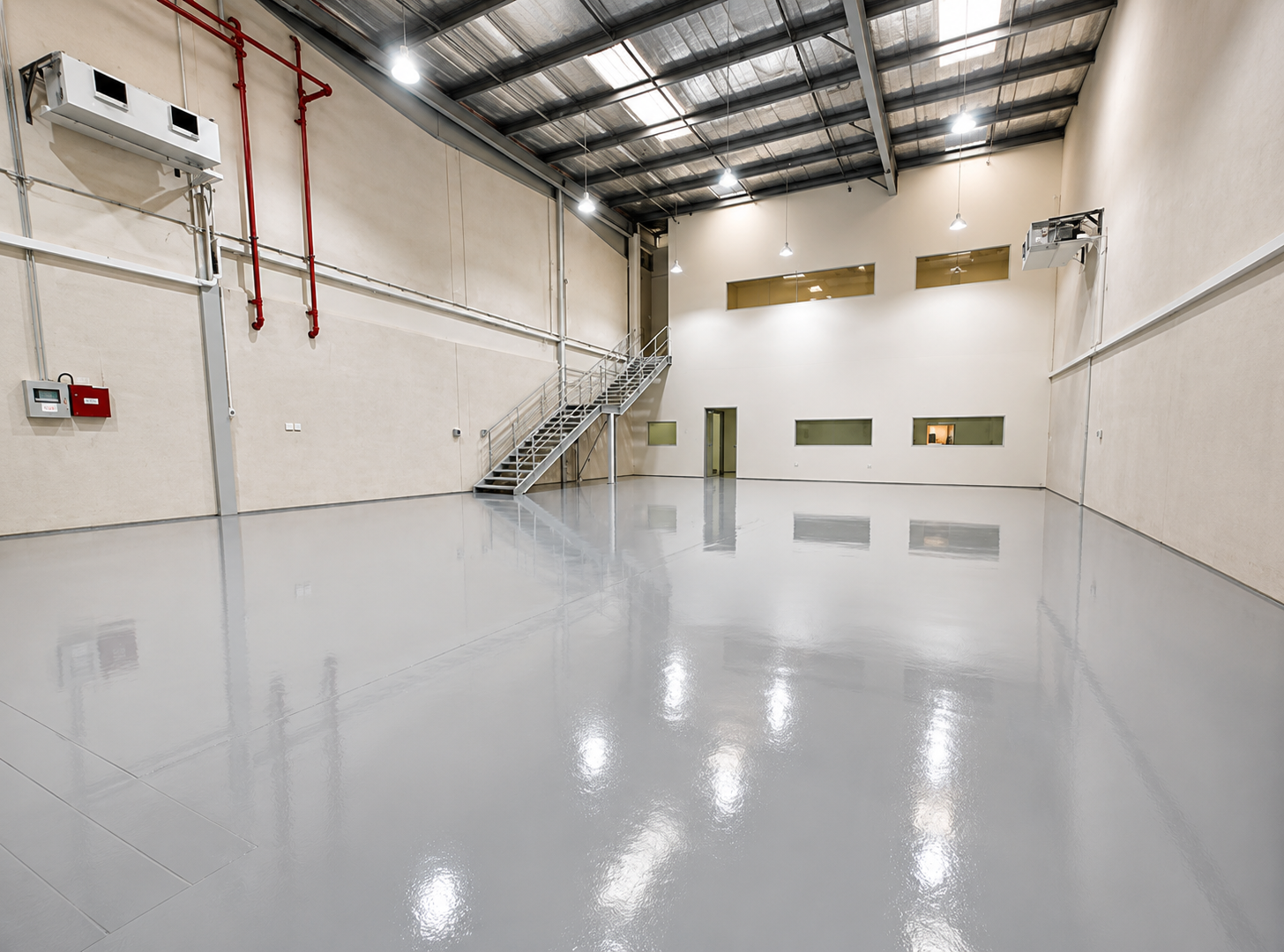
Epoxy Flooring vs Traditional Flooring: Which Is Better for Industrial Facilities?
When you have spent years working around industrial buildings, warehouses, workshops and commercial facilities, you learn one important lesson about flooring: a floor is not just a surface to walk on.
It carries equipment, forklifts, storage racks, machinery, materials and people every day. It gets exposed to oil, water, chemicals, dust, impact, constant traffic and regular cleaning. When the wrong flooring is selected, problems usually do not appear immediately. They develop slowly cracks become larger, surfaces start wearing down, dust becomes a problem and maintenance becomes more frequent.
This is one of the reasons epoxy flooring has become increasingly popular for industrial and commercial applications.
But does that mean epoxy is always better than traditional flooring?
Not necessarily.
The right choice depends on how the facility is used, what the floor is exposed to, how much traffic it receives and what the business expects from the floor over the next several years.
For businesses considering epoxy flooring in Dubai, this comparison explains the practical differences between epoxy and traditional flooring and what should be considered before making a decision.
What Is Epoxy Flooring?
Epoxy flooring is a protective resin based system applied over a properly prepared concrete surface. Once the resin and hardener are mixed and cured, they form a hard, continuous surface that bonds to the underlying floor.
What makes epoxy different from an ordinary concrete floor is the protection it provides.
A properly installed epoxy floor can help protect concrete against abrasion, stains, oil, moisture and many commonly encountered industrial chemicals. Depending on the application, the system can also be designed with additional thickness, texture, or anti slip properties.
However, good epoxy flooring is not simply a matter of rolling a coating over concrete. Surface preparation is just as important as the coating itself. If the concrete is not properly prepared, even a high quality epoxy system can eventually fail.
That is something experienced flooring professionals learn very quickly.
What Do We Mean by Traditional Flooring?
Traditional industrial flooring generally includes unfinished or finished concrete, cement screed, tiles and other conventional flooring materials.
Concrete remains one of the most widely used materials in industrial buildings because it is strong, readily available, and provides a reliable structural base.
The problem is that a concrete base and a finished industrial floor are not always the same thing.
Over time, untreated concrete can become dusty and stained. Repeated forklift traffic can wear the surface. Oil and other liquids can penetrate the concrete. Cracks may develop, particularly where the substrate or surrounding conditions are not properly managed.
Tiles have their own challenges. In high traffic environments, individual tiles can crack or break, while grout joints can become difficult to clean and maintain.
Traditional flooring can certainly work in the right environment. The question is whether it can continue performing under the specific conditions of your facility.
Epoxy Flooring vs Traditional Flooring
1. Durability Under Heavy Industrial Traffic
Industrial floors take punishment every day.
A warehouse may have forklifts moving pallets for several hours a day. A workshop may have heavy equipment sitting in the same location for years. A manufacturing facility may experience continuous movement of materials and machinery.
This type of environment requires a floor designed around actual operating conditions.
A properly specified industrial epoxy flooring in Dubai system can provide a hard wearing surface capable of handling significant pedestrian and vehicle traffic.
Traditional concrete is also strong, but the exposed surface can deteriorate over time. Once the surface begins to wear, repairing individual problem areas may become a recurring maintenance task.
Epoxy does not make the concrete underneath stronger structurally, but it can provide an additional protective layer that helps the surface withstand everyday industrial use.
2. Resistance to Oil, Chemicals and Spills
Anyone who has managed an industrial facility knows that spills are sometimes unavoidable.
Oil, grease, cleaning chemicals, fuels, water and other liquids can end up on the floor. With untreated concrete, these substances can penetrate the surface and leave permanent stains or contribute to deterioration.
An appropriate epoxy system can provide much better resistance to many common industrial substances.
But there is an important point here: not every epoxy coating has the same chemical resistance.
If a facility handles aggressive chemicals, the flooring system needs to be selected specifically for those chemicals and their concentration, temperature and exposure time.
This is why experienced industrial flooring contractors in Dubai do not recommend a flooring system based only on how it looks in a sample photograph. The working environment matters.
3. Cleaning and Maintenance
Maintenance is where many businesses begin to appreciate a good industrial floor.
A worn concrete surface can produce dust and may be difficult to clean thoroughly. Cracks, pits and rough areas can collect dirt and debris. Tile floors may have grout lines that require additional attention.
A properly installed epoxy floor provides a smooth, seamless surface with fewer areas where dirt and liquids can collect.
For facilities that are cleaned frequently, this can make everyday maintenance considerably easier.
It also helps create a cleaner and more professional working environment, which is particularly valuable for businesses where customers, suppliers, auditors, or employees regularly enter operational areas.
4. Safety and Slip Resistance
A good industrial floor should not only be durable. It should also support safe movement around the facility.
One common mistake is assuming that every smooth epoxy floor is automatically suitable for every environment.
If an area regularly becomes wet or exposed to oil, the flooring system may need an anti slip finish or aggregate. The level of texture should be chosen according to the conditions of the site.
For example, a dry warehouse walkway may have different requirements from a workshop where oil and water are frequently present.
The best industrial flooring solutions in Dubai are therefore based on how the floor will actually be used not simply on the appearance of the finished coating.
5. Appearance and Organisation
There was a time when industrial flooring was mostly about function.
Today, businesses expect more.
A well finished epoxy floor can make an industrial facility look cleaner, brighter and better organised. Different colours can be used to identify working areas, pedestrian routes, storage zones or safety boundaries.
Floor markings can also help improve the overall organisation of a warehouse or production facility.
While appearance should never be the main reason for selecting an industrial floor, there is no reason a hard working floor cannot look professional as well.
Epoxy flooring is often cheaper upfront than high end traditional options like hardwood or stone tile , but it can cost more than basic carpet or vinyl
This is one of the first questions most businesses ask and understandably so.
The initial cost of an epoxy system may be higher than simply leaving a concrete floor untreated. But comparing flooring purely on installation price can lead to the wrong decision.
A more useful question is :
How much will this floor cost the business over its useful life?
Consider the cost of:
- Regular repairs
- Surface deterioration
- Cleaning and maintenance
- Dust control
- Replacement of damaged areas
- Operational disruption
- Downtime during repairs
- Safety related issues
A cheaper floor that requires repeated repairs may ultimately cost more than a properly installed protective flooring system.
This is why businesses should evaluate epoxy floor coating in Dubai options based on performance and long term value, not just the initial quotation.
Where Does Epoxy Flooring Make the Most Sense?
Epoxy flooring can be an excellent choice for facilities where the floor experiences demanding daily conditions.
Typical applications include:
- Warehouses
- Manufacturing facilities
- Workshops
- Garages
- Industrial storage areas
- Production units
- Mechanical areas
- Commercial back of house spaces
- Loading and service areas
It is particularly useful where there is heavy traffic, regular cleaning, oil exposure, dust concerns or a requirement for a more durable finished surface.
That said, epoxy is not a universal solution.
Before installation, the existing concrete needs to be inspected. Moisture, cracks, previous coatings, contamination, surface strength and general substrate condition can all affect the final result.
Why Surface Preparation Matters So Much
After years of seeing flooring projects succeed and fail, one thing is clear: most flooring problems start underneath the coating.
If the concrete is contaminated with oil, moisture, dust or loose material, the epoxy cannot form the bond it needs.
Professional preparation may involve mechanical grinding, shot blasting, cleaning, crack repairs, removal of previous coatings and other treatments depending on the condition of the floor.
Only after the substrate is properly prepared should the selected coating system be installed.
This is one of the reasons choosing experienced industrial flooring contractors in Dubai is so important.
A good flooring contractor does not simply sell you a product. They should first understand the floor, the facility, the traffic, the environment and the expected performance.
How Stofix Technical Services Approaches Industrial Flooring
At Stofix Technical Services, we understand that every industrial facility has different requirements.
A warehouse floor carrying light pedestrian traffic does not have the same requirements as a manufacturing floor handling forklifts and heavy equipment. Similarly, a workshop exposed to oil requires different considerations from a dry storage facility.
The objective should always be to identify the actual requirements of the site and recommend a practical flooring solution that provides durability, functionality, and long term value.
Stofix Technical Services provides technical and facility related solutions for commercial and industrial environments, with an approach focused on quality workmanship and practical results.
For more information about Stofix Technical Services and its services, visit the official website: https://www.stofixts.com/
So, Which Flooring Is Better?
There is no honest answer that says epoxy is always better and traditional flooring is always worse.
Traditional concrete can be perfectly suitable for some facilities, particularly where traffic and environmental exposure are limited.
But when a facility deals with heavy traffic, forklifts, machinery, oil, chemicals, frequent cleaning or demanding maintenance requirements, a professionally installed epoxy system can offer significant advantages.
The important thing is not simply choosing epoxy.
It is choosing the right flooring system for the actual conditions of the facility and making sure the substrate is properly prepared before installation.
That is where professional experience makes a difference.
A floor may look excellent on the day it is completed, but the real test comes months and years later, when forklifts are running over it, machinery is operating, cleaning is taking place and the facility is working at full capacity.
That is the standard an industrial floor should be designed to meet.
FAQs:
1. Is epoxy flooring suitable for heavy industrial use?
Yes. Industrial grade epoxy systems can be designed for areas exposed to heavy pedestrian traffic, forklifts, machinery, abrasion and regular cleaning. The system should be selected according to the actual load and operating conditions.
2. How long can an epoxy industrial floor last?
The service life depends on the quality of the substrate, preparation, epoxy system, traffic, chemical exposure, maintenance, and installation. A correctly specified and professionally installed system can provide many years of reliable service.
3. Can epoxy flooring be used in warehouses?
Yes. Epoxy flooring is commonly considered for warehouses because it provides a hard, seamless surface that is easier to clean and can be designed to handle forklift and pallet movement.
4. Is epoxy flooring resistant to chemicals?
Many epoxy systems provide good resistance to common industrial chemicals, oils and solvents. However, chemical resistance varies between products, so the coating should be selected based on the specific substances used at the facility.
5. Is epoxy flooring slippery?
Epoxy itself is not necessarily slippery, but a smooth surface can become slippery when wet or contaminated with oil. Anti slip aggregates or textured finishes can be incorporated where the working environment requires additional traction.
6. Can epoxy be applied over an existing concrete floor?
In many cases, yes. However, the concrete must be inspected and properly prepared first. Existing cracks, contamination, moisture, weak areas and previous coatings may need to be addressed before the epoxy is installed.
7. Why is professional installation important for epoxy flooring?
The preparation of the concrete is critical to the performance of an epoxy floor. Poor preparation can lead to adhesion problems, peeling, bubbling or premature failure. Professional installation helps ensure the flooring system is properly matched to the site.
Final Word
For an industrial facility, flooring should be treated as part of the operation not simply as a finishing material.
The right floor can make cleaning easier, withstand daily traffic, protect the concrete underneath, improve workplace organization and reduce unnecessary maintenance.
For businesses looking for epoxy flooring in Dubai, industrial epoxy flooring in Dubai or reliable industrial flooring solutions in Dubai, the best starting point is a proper assessment of the facility and its day to day requirements.
When the flooring system, substrate preparation and installation method are all right, epoxy can be a very practical long term investment for demanding industrial environments.