
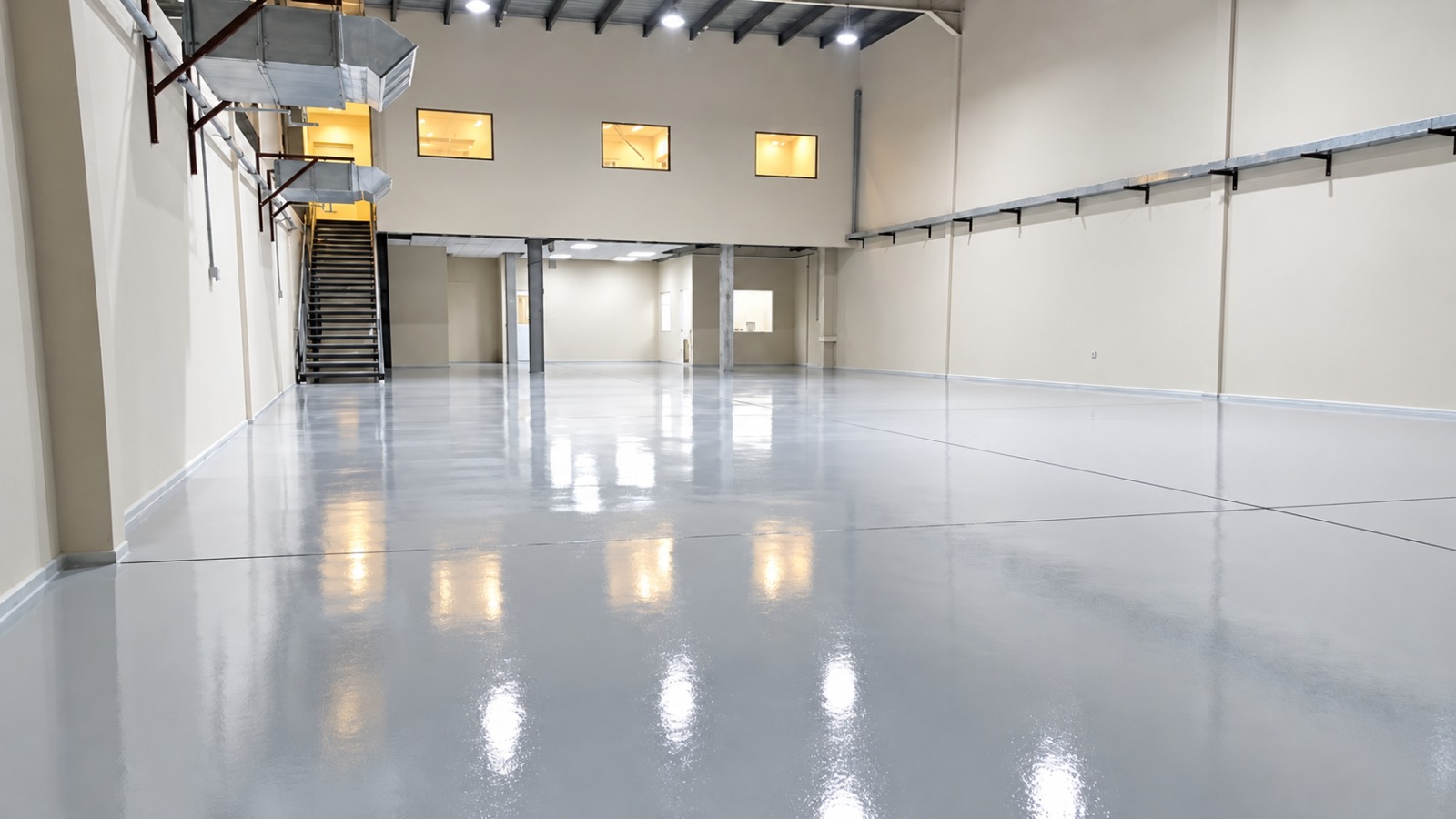
A warehouse floor has to handle far more than everyday foot traffic. It supports forklifts, pallet trucks, heavy storage racks, constant loading and unloading, material movement, oil and chemical exposure, and thousands of hours of operational activity. When the flooring is poorly designed or inadequately installed, even minor surface problems can quickly become expensive operational issues.
For modern businesses, flooring should therefore be considered an important part of the overall warehouse storage solutions strategy. A well-designed floor improves safety, supports efficient material handling, protects the building structure, and creates a cleaner working environment.
One of the most practical flooring options for industrial and commercial facilities is epoxy flooring. When properly specified and professionally installed, epoxy can provide a hard-wearing, seamless surface capable of handling demanding warehouse conditions.
Stofix Technical Services provides technical and fit-out solutions for commercial and industrial environments, helping businesses create functional spaces that are designed around their operational requirements.
What Is Epoxy Flooring?
Epoxy flooring is a resin-based flooring system created by combining epoxy resin with a hardener. Once the components are mixed and applied to a properly prepared concrete substrate, they chemically react and form a strong, bonded surface.
Unlike conventional painted floors, professionally installed epoxy flooring creates a much more durable finish. Depending on the specification, the system can be designed to provide resistance against abrasion, impact, chemicals, moisture, stains, and heavy traffic.
This makes epoxy particularly suitable for warehouses, logistics facilities, workshops, manufacturing areas, distribution centres, and other high-use commercial environments.
Why Is Epoxy Flooring Important for Warehouses?
Warehouse operations depend on movement. Forklifts travel between storage aisles, employees move inventory, pallets are loaded and unloaded, and equipment operates throughout the day.
A damaged, uneven, dusty, or deteriorating floor can interfere with these activities. Cracks, potholes and surface deterioration can create trip hazards, affect forklift movement and contribute to damage to equipment or stored goods.
A properly installed epoxy floor provides a smooth, continuous surface that is easier to maintain and better suited to demanding warehouse operations.
This is particularly valuable when flooring is being considered as part of a wider commercial warehouse storage solution, where flooring, storage systems, access routes, safety markings and material-handling requirements need to work together.
Key Benefits of Epoxy Flooring for Warehouses
1. Excellent Durability
Durability is one of the main reasons epoxy flooring is widely used in industrial environments.
A warehouse floor is exposed to repeated mechanical stress every day. Forklift wheels, pallet movement, dropped materials and heavy equipment can gradually wear down ordinary concrete surfaces.
A properly selected epoxy system creates a tough protective layer over the concrete. The exact level of performance depends on factors such as the epoxy formulation, thickness, substrate condition, traffic levels and installation quality.
For facilities with demanding operations, the flooring specification should always be based on actual usage rather than simply choosing the strongest-looking product.
2. Resistance to Heavy Traffic
Warehouses often have clearly defined traffic routes where forklifts and other equipment repeatedly travel along the same paths.
Epoxy flooring can withstand this type of regular traffic when the system has been correctly designed for the expected load.
Before installation, contractors should consider:
- Forklift traffic frequency
- Wheel type and loading
- Pallet truck movement
- Heavy machinery
- Expected impact
- Pedestrian traffic
- Storage rack locations
- Cleaning methods
Understanding these factors helps determine the appropriate flooring system.
3. Easy Cleaning and Maintenance
Warehouse cleanliness is not simply a matter of appearance. Dust, oil, grease and debris can affect workplace safety and operational efficiency.
The seamless nature of epoxy flooring makes the surface considerably easier to clean than rough or heavily deteriorated concrete. There are fewer joints and surface irregularities where dirt can accumulate.
Routine cleaning can help preserve the appearance and performance of the floor while allowing facility managers to identify damage at an early stage.
4. Improved Workplace Safety
A well-designed warehouse floor can contribute to a safer working environment.
Epoxy systems can be specified with anti-slip properties where required. Different colours can also be used to visually separate pedestrian walkways, equipment routes, storage zones and operational areas.
This is particularly useful when flooring forms part of a broader warehouse storage solution in Dubai, where businesses need to make effective use of limited space while maintaining clear and safe movement routes.
However, flooring alone does not create a safe warehouse. It should work alongside appropriate lighting, signage, rack protection, access control and operational safety procedures.
5. Chemical and Stain Resistance
Warehouses may contain oils, cleaning chemicals, industrial liquids or other substances that can stain or deteriorate unprotected concrete.
Depending on the selected system, epoxy flooring can provide useful resistance against many common industrial chemicals.
The chemical environment should be assessed before installation. If the facility handles aggressive chemicals, the flooring system should be specifically selected for those substances rather than assuming that all epoxy products provide identical resistance.
6. Professional Appearance
A clean, well-finished warehouse creates a better impression for employees, customers, suppliers and visitors.
Epoxy flooring provides a uniform appearance and can be installed in different colours and finishes. This makes it possible to combine practical performance with a professional industrial environment.
For companies investing in a complete warehouse fit-out, coordinated flooring can also complement storage systems, partitions, lighting, signage and other interior elements.
Epoxy Flooring and Warehouse Storage Solutions
Flooring should not be planned independently from storage requirements.
For example, the positioning of pallet racks, shelving systems and forklift aisles can influence where heavy traffic will occur. Storage height, load distribution and equipment movement can also affect the floor specification.
A professional approach to warehouse storage solutions therefore considers the entire operational environment.
Important considerations include:
- Storage rack configuration
- Forklift turning areas
- Loading and unloading zones
- Pedestrian walkways
- Emergency access routes
- Equipment movement
- Floor loading requirements
- Drainage and cleaning requirements
- Future expansion
Planning these elements together can help businesses avoid expensive modifications later.
Choosing the Right Warehouse Flooring System
Not every warehouse requires the same type of epoxy floor.
A small storage facility with limited pedestrian traffic has different requirements from a logistics centre operating forklifts continuously throughout the day.
The right specification should consider:
Traffic Conditions
Determine how many forklifts, pallet trucks and other vehicles will operate on the floor and how frequently they will use particular routes.
Load Requirements
Heavy storage racks and industrial equipment may place significant loads on the concrete slab. The flooring system should be selected with the existing substrate and operational loads in mind.
Environmental Conditions
Dubai’s climate presents additional considerations, particularly regarding temperature, dust, humidity and building conditions. Proper substrate preparation and moisture assessment are essential before installation.
Chemical Exposure
If the facility uses oils, solvents, cleaning agents or other chemicals, the flooring system should be selected according to the specific exposure.
Slip Resistance
Areas where water, oil or other liquids may be present may require an appropriately textured or slip-resistant finish.
Epoxy Flooring Installation Process
A high-quality epoxy floor is only as good as the preparation beneath it. In experienced flooring work, surface preparation is often more important than the final coating itself.
Step 1: Site Inspection
The first stage is a detailed inspection of the existing floor.
The contractor should assess:
- Concrete condition
- Cracks and damaged areas
- Existing coatings
- Moisture conditions
- Uneven surfaces
- Contamination
- Expansion joints
- Previous repairs
This assessment helps determine the appropriate preparation and repair strategy.
Step 2: Surface Preparation
The concrete must be properly prepared before epoxy is applied.
Depending on the condition of the floor, preparation may involve mechanical grinding, shot blasting, removal of old coatings, cleaning and repair work.
The objective is to create a clean, sound and suitably profiled surface that allows the epoxy to bond correctly.
Skipping or rushing this stage can lead to problems such as peeling, blistering or premature failure.
Step 3: Crack and Surface Repairs
Existing cracks, damaged concrete and uneven areas should be addressed before coating.
The repair method depends on the cause and severity of the damage. Simply covering a structural or moving crack with epoxy does not eliminate the underlying problem.
This is where practical site experience becomes important. The contractor needs to distinguish between cosmetic surface defects and issues that require more extensive repair.
Step 4: Primer Application
A suitable primer may be applied to improve adhesion between the concrete substrate and the epoxy system.
The primer also helps create a consistent foundation for subsequent layers.
Step 5: Epoxy Base Coat
The selected epoxy material is then applied according to the manufacturer’s technical specifications.
Application thickness, mixing ratios, temperature, working time and curing conditions all matter. Poor mixing or incorrect application can compromise the performance of the finished floor.
Step 6: Additional Coats or Build Layers
Depending on the required performance, additional epoxy layers may be installed.
Industrial warehouse floors may require a thicker system than a light-duty commercial area. The final specification should be based on traffic, impact, chemical exposure and expected service conditions.
Step 7: Anti-Slip Treatment and Markings
Where necessary, anti-slip aggregates can be incorporated into the system.
Floor markings can also be introduced to define forklift lanes, pedestrian routes, storage areas and other operational zones.
These details can make a significant difference to the practical usability of a warehouse.
Step 8: Curing and Final Inspection
The floor needs adequate curing time before normal operations resume.
Premature traffic can damage a newly installed coating. The required curing period depends on the product system and environmental conditions.
Before handover, the finished surface should be inspected for uniformity, adhesion, defects, coverage and overall finish.
Integrating Flooring With a Warehouse Fit-Out
A warehouse has more than four walls and a floor. Modern facilities often require carefully coordinated storage, workspace and operational systems.
A complete warehouse fit out Dubai project may involve flooring, partitions, storage systems, office areas, lighting, electrical works, safety features and other technical installations.
Coordinating these elements from the beginning can improve project efficiency.
For example, storage rack positions should ideally be established before final floor markings are applied. Similarly, equipment routes should be considered when determining pedestrian walkways and safety zones.
Working with experienced warehouse fitout contractors can help businesses coordinate these requirements and reduce the risk of having to modify completed work.
Warehouse Storage Accessories and Flooring Considerations
Storage accessories may seem unrelated to flooring, but the two are closely connected.
Warehouse storage accessories can include:
- Rack protection systems
- Pallet supports
- Safety barriers
- Rack labels
- Bin systems
- Mesh panels
- Safety signage
- Corner guards
- Aisle markers
- Material-handling accessories
These components influence how people and equipment move around the facility.
A well-planned warehouse combines the flooring, storage equipment and safety infrastructure into one practical system rather than treating every component as a separate project.
Common Mistakes to Avoid When Installing Epoxy Flooring
Choosing Based Only on Price
The cheapest quotation is not necessarily the most economical solution.
A low initial price may reflect a thinner system, inadequate preparation or a product that is not suitable for the operational conditions.
The better approach is to compare the complete specification, preparation method, material system, thickness, warranty and expected service conditions.
Ignoring the Existing Concrete
Epoxy does not correct fundamental problems in a concrete slab.
If the substrate is weak, contaminated, damp or severely damaged, these issues need to be addressed before coating.
Rushing Surface Preparation
Poor preparation is one of the most common causes of coating failure.
A technically excellent epoxy product cannot compensate for poor adhesion caused by an inadequately prepared substrate.
Allowing Traffic Too Early
A floor may look finished before it has fully cured.
Heavy equipment should not be allowed onto the surface until the contractor confirms that the coating has reached the required level of cure.
Treating Every Warehouse the Same
Every facility has different operational demands.
A distribution centre, cold-storage facility, workshop and general storage warehouse may require completely different flooring specifications.
Why Professional Installation Matters
Epoxy flooring is sometimes viewed as a straightforward coating job. In reality, successful installation requires knowledge of concrete, surface preparation, material behaviour, environmental conditions and site logistics.
An experienced contractor understands that the finished appearance is only one part of the project.
The real objective is to create a flooring system that continues to perform after months and years of forklift traffic, cleaning, loading and general warehouse activity.
This practical approach is particularly important in Dubai, where commercial properties often need to accommodate demanding schedules and high operational usage.
Stofix Technical Services approaches technical and fit-out requirements with an emphasis on practical functionality, quality workmanship and solutions suited to the specific requirements of each commercial environment.
Maintaining an Epoxy Warehouse Floor
Regular maintenance can significantly extend the useful life of an epoxy floor.
A practical maintenance programme should include:
- Regular sweeping and cleaning
- Prompt removal of oil and chemical spills
- Inspection of high-traffic areas
- Repair of damaged sections when necessary
- Monitoring of expansion joints
- Avoiding unsuitable cleaning chemicals
- Maintaining forklift wheels and equipment
- Keeping drainage areas clear
Warehouse managers should also monitor areas around loading bays, rack legs, turning points and frequently used routes because these locations generally experience higher levels of mechanical stress.
Final Thoughts
For businesses operating warehouses, flooring is an operational investment rather than simply an interior finishing material.
A properly specified and professionally installed epoxy floor can provide durability, easier maintenance, improved cleanliness, better traffic management and a more professional working environment.
When combined with carefully planned warehouse storage solutions, appropriate warehouse storage accessories, and an integrated warehouse fit out Dubai strategy, the result can be a facility that is safer, more efficient and better prepared for long-term use.
Whether the requirement involves flooring, storage planning or a complete commercial fit-out, selecting experienced warehouse fitout contractors is an important part of achieving a reliable result.
For businesses looking for practical technical and fit-out support, Stofix Technical Services can help develop solutions based on the actual requirements of the facility rather than applying a one-size-fits-all approach.
FAQs
1. Is epoxy flooring suitable for warehouses?
Yes. Epoxy flooring is widely used in warehouses because it can provide a durable, seamless and easy-to-maintain surface suitable for heavy traffic and demanding operating conditions.
2. How long does warehouse epoxy flooring last?
The service life depends on the epoxy system, installation quality, substrate condition, traffic levels and maintenance. A correctly specified and professionally installed system can provide many years of service.
3. Can epoxy flooring withstand forklifts?
Yes, when the flooring system is properly specified for forklift traffic. The contractor should consider vehicle weight, wheel type, traffic frequency and impact levels before selecting the system.
4. Is epoxy flooring easy to clean?
Yes. Its seamless and relatively smooth surface makes routine cleaning easier than heavily damaged or porous concrete floors.
5. Does epoxy flooring prevent concrete damage?
It provides a protective surface that can help protect concrete from abrasion, staining, moisture and certain chemical exposure. However, existing structural or major concrete problems should be repaired before installation.